

How Do I Get My Dog Registered As A Therapy Dog?
Westward lid is it about animals? As the bad news about the coronavirus continues, "send me dogs and cats" has become a regular cry on social media, an easy-to-grasp shorthand for "I feel terrible, cheer me up". The response is always the aforementioned: a torrent of pictures of animals doing daft things – only somehow it has a magical, calming effect.
The therapeutic value of our relationship with our pets, particularly dogs, is increasingly recognised by researchers. Cats can be wonderful too – just dogs have been domesticated by humans for much longer, and, as even the nearly devoted cat lover will admit, dogs are far easier to train for companionship. About cats, equally we know, are admirable for entirely dissimilar reasons. Marion Janner, a mental health campaigner and all-round creature lover, says that dogs teach us a whole range of lessons. "Dogs dearest us unconditionally. They're the ultimate in equal opportunities – entirely indifferent to race, gender, star sign, CV, dress size or ability to throw cool moves on the dance floor. The simplicity and depth of this love is a continuous joy, along with the health benefits of daily walks and the social delights of chats with other canis familiaris walkers. They teach kids to be responsible, altruistic and empathetic and, valuably just sadly, how to cope when someone you love dies."
Robert Doward* felt this odd effect when his health all of a sudden took a downward turn. "I'd been working incredibly difficult, long hours, too many days. 1 24-hour interval I started crying and but couldn't cease. I couldn't put sentences together properly. I'd been pushing everything so hard for so long, and I just couldn't exercise it any more than."
It took a long time to put himself back together: plus some therapy, another task and changes to his family life. But the primal factor, he says only one-half-jokingly, was a minor Greek rescue domestic dog called Maria. "Taking her out for walks, getting out into fresh air, but putting ane foot in forepart of the other, that lifts your spirits. And so there's nothing like having a dog curled upwardly abreast you, fifty-fifty when yous feel absolutely miserable. She'll check my face anxiously, equally if she knows something is wrong. And that makes me grinning – and that somehow makes you lot feel better. There is simply something magic about dogs. Honestly, she got me through."
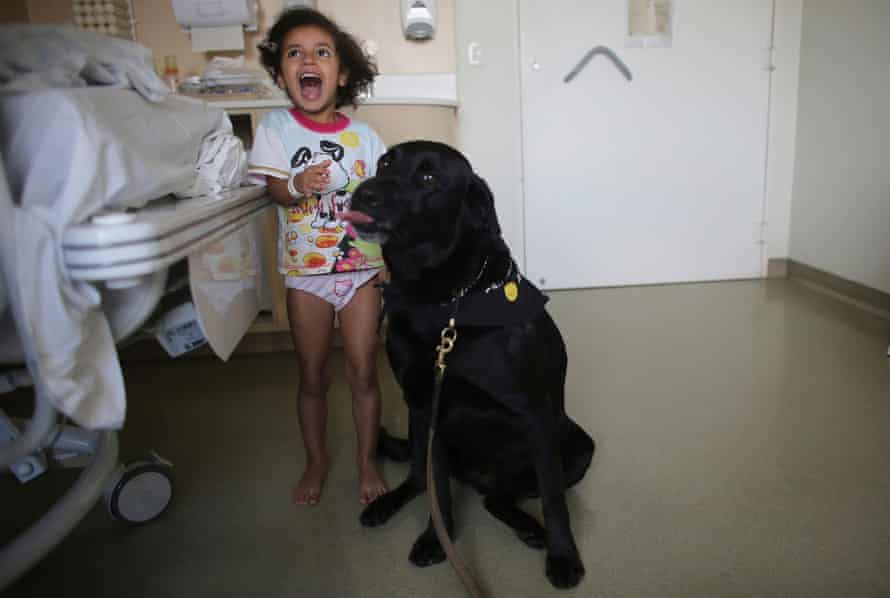
Photograph: Nacho Doce/Reuters
But why? What is responsible for these therapeutic furnishings? One key aspect appears to be social recognition – the process of identifying another existence as someone important and significant to you. The bond that forms between possessor and pet is, it seems, similar to the bail that a mother forms with her babe.
The importance of social recognition is increasingly acknowledged for the office it plays in helping united states of america course networks. Nosotros now empathise that healthy social bonds can play a primal office in mental wellness; without them, we get solitary, depressed and physically unwell. And pets, it seems, can fulfil that role. Academic and psychologist June McNicholas points out that pets can be a lifeline for socially isolated people.
"Pet intendance and self-care are linked. When you take a dog out for a walk, people talk to you and that may be the just social contact an isolated person has the whole day. If you have a true cat, you can have a conversation standing in the true cat food aisle in the supermarket, deciding which brand to purchase. When pet owners leave the firm to buy pet food, they're more likely to buy nutrient for themselves and when they feed their pet, they'll sit down downwardly to eat too. People with disabilities often discover that able-bodied people are socially awkward with them; if they have a dog it breaks downwards barriers and allows a more comfy and natural interaction."
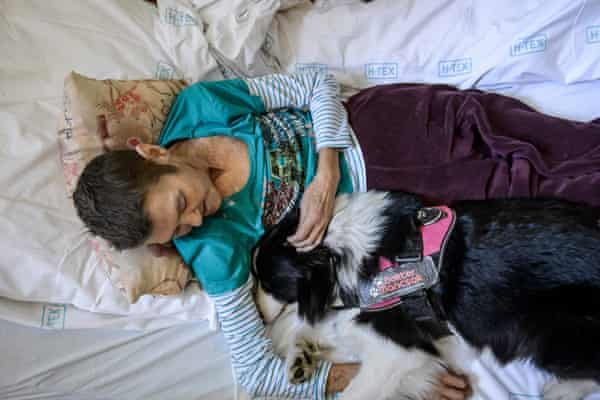
Social recognition is something humans share with a few (though not all) mammals, including sheep and prairie voles. We are primed to look subsequently those we have made social bonds with; we don't breastfeed just any erstwhile baby and we don't take random dogs domicile from the park. Author and researcher Meg Daley Olmert explains "When we call our domestic dog, 'our baby' it is considering we recognise it on a neural level as such. And this recognition triggers the same maternal bonding encephalon networks that let a female parent to wait at her cerise, slimy newborn and say, 'mine!'"
A small study of functional MRI encephalon scans in xviii women showed similar responses in regions involved in advantage, emotion and affiliation when the women looked at images of their child and pet dog.There were of import differences though; dogs caused activity in the fusiform gyrus (involved in facial recognition) and babies in the tegmentum (centres of reward and amalgamation). We dear our pets, but in a fire we're primed to save the babe.
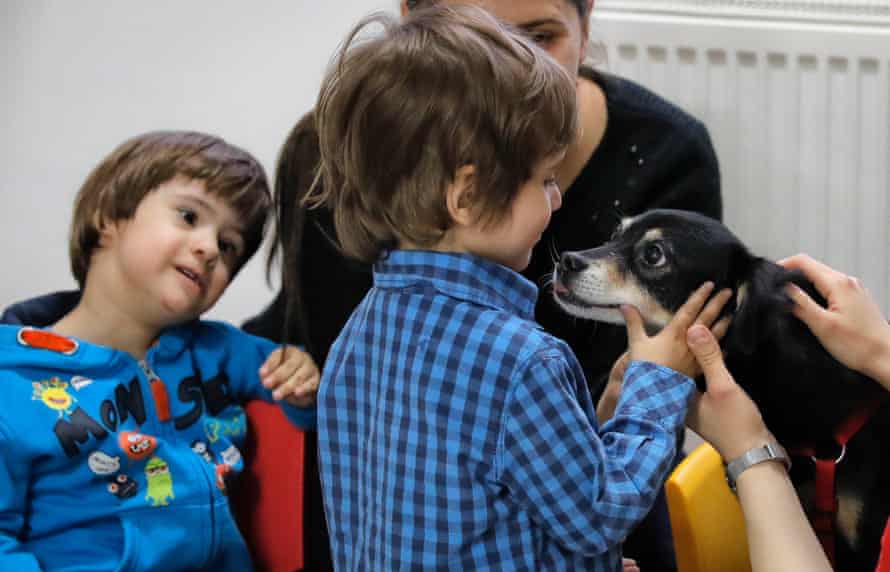
Although scientists have some understanding of social recognition and where it takes place in the brain, we still don't entirely understand how information technology happens. The missing link could exist oxytocin, the and so-called "hug", "dear" or "cuddle" hormone. Oxytocin has a key role in both childbirth, lactation and sperm movement, but it also has an increasingly recognised function in our social behaviour, interim as a chemical messenger in pathways that control sexual arousal, recognition, trust, mother-infant and human-pet bonding.
Oxytocin works in tandem with another brain hormone, vasopressin, to help to modulate our response to stress and deal with social situations. Unsurprisingly, there's a lot of involvement in a possible role for oxytocin in addiction, brain injury, anorexia, depression, autism and astringent anxiety.
And there are other reasons that pets and therapy animals are increasingly recognised equally being adept for our mental health. In addition to helping to alleviate stress, anxiety, low and loneliness, there are all the benefits that come from having to exercise a dog. Daily walks outdoors boost physical and emotional wellbeing. Chucking sticks, picking upward balls – even scooping upwardly canis familiaris poo – can provide an all-round workout.
Increasingly that knowledge is existence turned to practical use, with some lovely effects. When the Eye for Mental Health ran an evaluation on therapy dogs in prisons, for example, the feedback was off the scale. "I don't know what it is, simply even when I am running around with [the dog] I simply experience better within, calmer, more peaceful," said one prisoner. Another told the interviewer: "Dogs have a magic effect on you, you can feel their love and that just makes you lot feel better inside you lot."
The good feelings persist fifty-fifty after the dogs have left, the reviewers found, with one subject saying: "I just walk around for the rest of the day on deject 9."
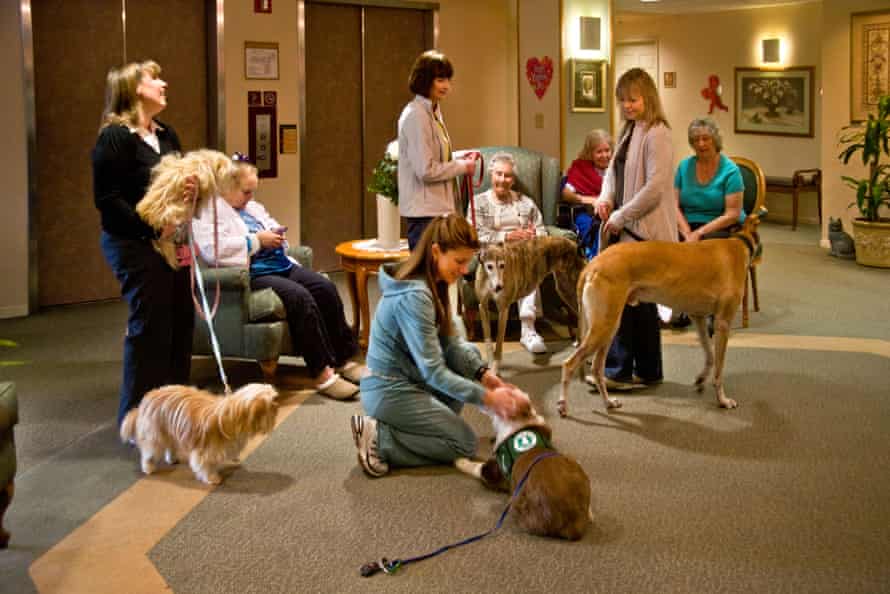
Photo: Marmaduke St John/Alamy
Some of the United kingdom of great britain and northern ireland's most dangerous and tearing mental health patients are cared for in 1 of iv high-security psychiatric hospitals. Near are diagnosed with schizophrenia and stay an boilerplate of vii years. The Country infirmary in Due south Lanarkshire, Scotland, is ane of these facilities and runs an animal therapy center which gives patients the take a chance to pet and treat a range of animals including chipmunks, rabbits, hens, geese, pygmy goats and pigs.
Staff say that creature therapy helps to develop problem-solving skills, empathy, attention to the needs of others, a sense of responsibleness and a way of channelling ambitious thoughts among individuals who accept proved difficult to reach with conventional psychiatric drugs and talking therapies.
But what if y'all don't have a pet? Is in that location whatever shortcut to reproducing the beneficial effects? 1 candidate is sildenafil (Viagra). Having sex causes an oxytocin surge in the brain and taking Viagra may reproduce that surge without the faff of mating. A more practical idea might exist an oxytocin spray or tablet.
Just biologist Sue Carter says that translating naturally occurring oxytocin into a commercially available production is challenging. Oxytocin has unique chemical properties and can shift form, making information technology hard to work with and measure. Importantly, "the effects of oxytocin are context dependent, sexually dimorphic (unlike in men and women), and contradistinct past experience."
Honestly? Gazing into your domestic dog's optics may produce a more reliable sense of wellbeing than whatever commercially bachelor synthetic product.
* Some names and details accept been changed.

Source: https://www.theguardian.com/society/2020/mar/17/dogs-have-a-magic-effect-the-power-of-pets-on-our-mental-health
Posted by: haughtyountop.blogspot.com
0 Response to "How Do I Get My Dog Registered As A Therapy Dog?"
Post a Comment